


Selecting the right instrumentation often feels like navigating a maze of specifications, but few decisions impact your process efficiency as heavily as the form factor of your measurement device. You have likely already decided on electromagnetic technology—leveraging Faraday’s Law for its non-intrusive design and minimal pressure drop—but the specific physical configuration is the next critical hurdle. Choosing the wrong structural type can lead to immediate installation nightmares, long-term maintenance inaccessibility, or wasted capital on oversized hardware.
The stakes are high. An integrated unit installed on a vibrating pump line can fail within months due to electronics fatigue, while specifying a full-bore meter for a 40-inch water main might cost ten times more than necessary. To optimize both budget and performance, you must understand the distinct roles of the three primary configurations. This guide defines the comparison scope: the pipeline flow meter (inline/integrated) for precision, the split (remote) model for harsh environments, and the plug-in (insertion) model for cost-efficiency in large lines.
Pipeline/Inline Models: Best for high-accuracy (<0.5%) requirements and smaller pipe diameters; offers the most stable velocity profile reading.
Split Models: Essential for high-vibration, high-temperature, or submerged environments where protecting electronics is paramount.
Plug-in/Insertion Models: The ROI champion for large pipes (>8 inches); sacrifices slight accuracy for massive installation savings and "hot-tap" (no shutdown) capability.
Critical Constraint: All types require conductive fluids (>5 µS/cm); non-conductive hydrocarbons remain the domain of Coriolis or Ultrasonic meters.
Before diving into the mechanical specifics of each device, you must evaluate three primary variables in your application. These factors dictate whether you need a heavy-duty inline unit or a flexible insertion probe. The decision rarely relies on a single data point; rather, it involves balancing accuracy needs against installation realities.
We typically use a decision matrix based on three pillars:
Pipe Diameter: This is where the cost curve bends. Small pipes almost always favor inline models, while large diameters shift the economic advantage toward insertion types.
Accessibility & Environment: If the measurement point is in a flooded pit, high up on a gantry, or next to a steam boiler, the physical location of the electronics becomes the deciding factor.
Accuracy Requirements: You must distinguish between custody transfer (where every drop counts for billing) and general process monitoring (where a 2% variance is acceptable).
Regardless of the form factor, every electromagnetic flow meter shares one non-negotiable constraint: the fluid must be conductive. The technology relies on the fluid acting as a conductor moving through a magnetic field to generate a voltage signal.
This works perfectly for water, acids, caustics, and water-based slurries. Industry standards typically require a minimum conductivity of 5 µS/cm. If you are measuring deionized water, hydrocarbons, oils, or fats, this technology will fail regardless of the model you choose. In those non-conductive scenarios, you would likely need to switch to ultrasonic or Coriolis technologies.
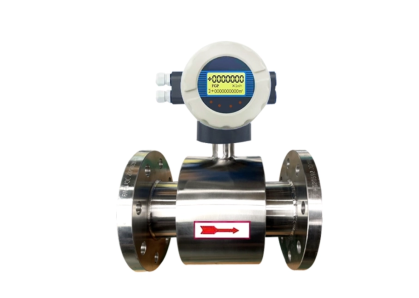
The pipeline flow meter, often referred to as an inline or full-bore meter, represents the traditional gold standard for magnetic flow measurement. In this configuration, the meter body is a spool piece that installs directly in line with the piping, becoming an integral part of the process boundary.
You should choose this configuration when precision is mandatory. Applications involving custody transfer, precise chemical dosing, or critical process control loops require the tight tolerances that only inline meters provide. These devices typically deliver accuracy better than ±0.5% of the reading, with premium models achieving ±0.2%.
The primary advantage of the pipeline design is its ability to analyze the full cross-section of the flow. By measuring the average velocity across the entire pipe diameter, the meter mitigates errors caused by flow profile disturbances.
Fluids flowing through pipes shift between laminar and turbulent states based on velocity and viscosity (Reynolds number). A full-bore meter averages these shifts more effectively than single-point measurement devices. Furthermore, these meters come with robust liner options. You can specify materials like PTFE (Teflon) or PFA, which provide exceptional resistance against aggressive chemical corrosion or abrasive slurries.
Pipeline models adapt to various industry standards through different connection methods:
Flange: The most common connection for industrial use. It offers high pressure ratings and stability, adhering to ISO or ANSI dimension standards.
Wafer (Sandwich): These flangeless bodies are clamped between the user’s pipe flanges using long bolts. They are compact and lower cost for pipes under 200mm but generally carry lower pressure ratings than flanged versions.
Sanitary (Tri-Clamp): Essential for pharmaceutical and food and beverage industries, these connections allow for quick disassembly and are compatible with Clean-In-Place (CIP) protocols.
The downside of the pipeline approach is capital expenditure (CAPEX) scaling. As pipe diameter increases, the cost of the meter rises sharply due to the sheer volume of copper coils and steel required. For pipes larger than 12 inches, the price can become prohibitive. Additionally, installation requires shutting down the line and cutting the pipe, which can result in significant downtime.
A split flow meter—also known as a remote type—technically uses the same sensor body as the pipeline model but separates the electronic brain (converter) from the sensing element.
Standard integrated meters mount the display and electronics directly on top of the flow tube. While convenient, this places sensitive microprocessors right in the line of fire. Split models solve the problem of protecting these components from the process environment.
You should specify a split configuration in the following scenarios:
High Temperature: When fluid temperatures exceed 60°C–120°C, heat radiates from the pipe into the electronics housing. This can degrade capacitors and shorten the lifespan of the display. Split cabling allows you to mount the converter away from the heat source.
Vibration: Pipes near heavy reciprocating pumps often vibrate intensely. This mechanical energy can shatter LCD screens or crack solder joints on Printed Circuit Boards (PCBs) in integrated units. Remote mounting isolates the electronics from this vibration.
Submersion: In water treatment, flow meters often reside in pits that may flood. By using an IP68-rated remote sensor, the measuring tube can survive underwater while the converter remains dry in a control room or a grade-level cabinet.
Inaccessible Locations: If a pipe runs 20 feet in the air or in a confined space, reading a local display is impossible. A split system brings the interface down to eye level for safe operation.
While they offer superior durability, split systems introduce installation complexity. You must run specialized signal cables between the sensor and the transmitter. Because the raw signal from the electrodes is in millivolts, it is susceptible to electromagnetic interference. Strict grounding protocols and the use of factory-potted, shielded cables are required to protect signal integrity.
For large water mains, effluent lines, or district heating networks, the plug-in flow meter (or insertion meter) changes the economic equation. Instead of a full spool piece, this device uses a probe inserted through a small opening in the pipe wall.
The cost of an inline meter increases linearly (or exponentially) with pipe size. However, the cost of an insertion meter remains virtually flat regardless of the line size. The same probe mechanism fits a 6-inch pipe and an 80-inch pipe. Once you cross the 8-inch or 10-inch diameter threshold, the insertion model becomes the clear ROI champion.
The most distinct operational benefit is "hot-tapping." You can install a plug-in meter under pressure without shutting down the process flow. The installation typically involves welding a nozzle to the pipe, mounting a valve, and drilling through the open valve. The probe is then inserted through the valve and sealed.
This capability is a critical requirement for municipal water distribution networks where cutting supply to thousands of homes to install a meter is not an option.
You do trade some performance for these savings. Insertion meters measure "point velocity"—the speed of the fluid at the specific tip of the probe. The transmitter then calculates the total flow based on assumptions about the flow profile across the rest of the pipe. If the flow profile is distorted, the calculation will be off.
Consequently, these meters are extremely sensitive to installation conditions. They typically require longer upstream (10D) and downstream (5D) straight pipe runs compared to inline models to ensure the flow profile is fully developed and predictable.
Maintenance is generally straightforward. Retraction mechanisms, often using a simple ball valve assembly, allow you to pull the probe out for cleaning without draining the system. This is useful in wastewater applications where electrodes might foul over time.
Making the final choice requires balancing Total Cost of Ownership (TCO) against the specific risks of your facility. The comparison below highlights the functional differences.
| Feature | Pipeline (Inline) | Split (Remote) | Plug-in (Insertion) |
|---|---|---|---|
| Accuracy | High (±0.2% to 0.5%) | High (±0.2% to 0.5%) | Moderate (±1.0% to 2.0%) |
| Pipe Size Suitability | Best for 0.5" to 12" | Best for 0.5" to 12" | Best for >8" to 80"+ |
| Install Impact | Requires pipe cutting | Pipe cutting + cabling | Hot-tap (No shutdown) |
| Environmental | Standard industrial | High Temp / Submerged | Standard industrial |
| Cost Trend | Increases with size | Increases with size | Flat cost regardless of size |
For small pipes (under 6 inches), the flow meter hardware cost difference between inline and insertion is negligible, yet the inline meter offers far superior performance. Thus, inline is the logical choice. However, as you approach pipes larger than 12 inches, inline hardware costs explode. In these sizes, an insertion meter can offer 50% to 80% CAPEX savings, drastically altering the ROI calculation.
Regardless of type, grounding remains the most common failure point. A magnetic flow meter measures a voltage signal generated by the fluid. If the fluid is not referenced to "zero" (ground), the signal floats, leading to erratic readings. On plastic or lined pipes, you must install grounding rings to establish this reference.
Liner protection is another nuance. With inline meters, over-torquing flange bolts can crush the PTFE liner, ruining the device before it is even powered on. Conversely, insertion meters face the risk of probe bending if they are installed in lines with velocity surges that exceed the probe's mechanical rating.
Choosing the correct electromagnetic configuration is not about finding a universally "better" device, but rather finding the one that fits your specific constraints. The technology is sound; the application is where the challenge lies.
Choose Pipeline models when chemical resistance and high accuracy are your priorities, particularly in pipes smaller than 12 inches.
Choose Split systems when you must ensure longevity in areas with high heat, vibration, or flood risks.
Choose Plug-in probes for budget efficiency in large water or wastewater lines where shutting down flow is impossible.
Before finalizing your Purchase Order, always verify two things: that your fluid has sufficient conductivity (>5 µS/cm) and that your piping layout offers enough straight run length to support the chosen meter type.
A: Generally, the cost tipping point occurs around the 8 to 10-inch pipe diameter mark. Below this size, the cost of an inline meter is reasonable, and its superior accuracy makes it the better buy. Above 12 inches, the material costs for inline meters rise sharply, making the insertion meter significantly cheaper.
A: Yes, they are ideal for this. You must ensure the sensor body is rated IP68 (submersible) and that the cable entry points are factory-potted and sealed. The converter (electronics) must be mounted remotely in a dry, safe area, connected by the sealed cable.
A: Yes, they are more sensitive to flow profile disturbances than inline models. While inline meters might handle 5 diameters upstream, plug-in models often require 10 to 20 diameters of straight pipe upstream to ensure the single-point velocity reading accurately represents the average flow.
A: Plastic acts as an electrical insulator, isolating the fluid from the pipe wall. The meter needs the fluid to be at a stable electrical potential (ground) to measure the induced voltage. Without grounding rings or a grounding electrode, the signal has no reference, leading to drifting or zero readings.

